University of Guyana Press Launches Professor Emeritus Jay Mandle’s Latest Publication
Monday, October 19, 2026 - 09:26Professor Emeritus Jay Mandle,
W. Bradford Wiley Professor of Economics, Emeritus, at Colgate University, and a member of the Advisory Board of the University of Guyana Green Institute
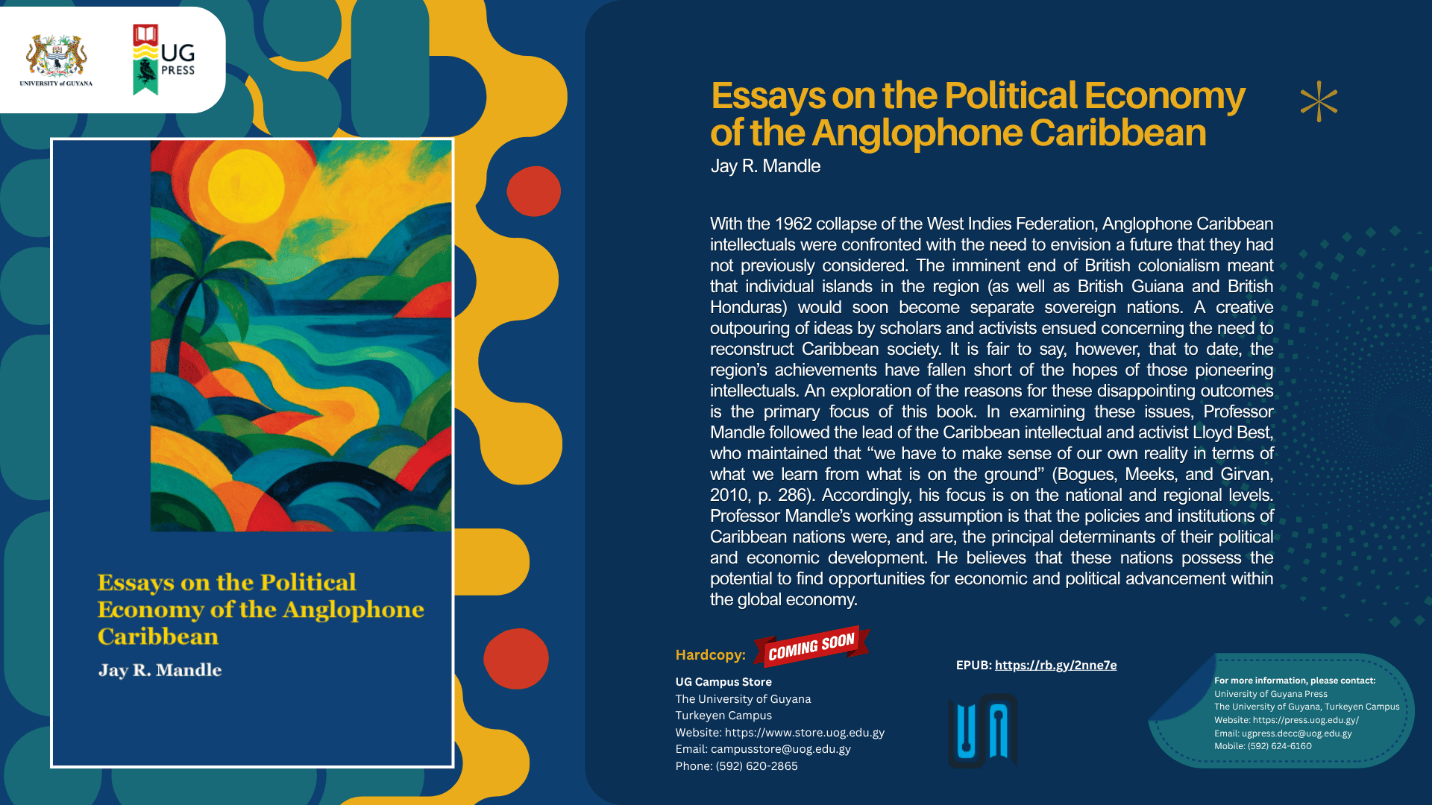
The University of Guyana, in partnership with the University of Guyana Press, launched Professor Jay Mandle’s latest publication, Essays on the Political Economy of the Anglophone Caribbean, on Tuesday, October 6, 2026.
Professor Mandle, the W. Bradford Wiley Professor of Economics, Emeritus, at Colgate University and a member of the Advisory Board of the University of Guyana Green Institute, critically examines, in his latest work, the region’s failure to fully realise the ideals articulated by the early intellectuals, scholars, and political thinkers who shaped the discussions that followed the collapse of the West Indies Federation. Thinkers such as Walter Rodney, Lloyd Best, and Arthur Lewis undertook the task of envisioning a new future for the newly independent and soon-to-be-independent countries of the Anglophone Caribbean. Professor Mandle argues that the region’s achievements have fallen short of the aspirations of these pioneering intellectuals for a myriad of reasons, all of which he explores in the book. In examining these issues, Professor Mandle follows the lead of Caribbean intellectual and activist Lloyd Best, who maintained that “we have to make sense of our own reality in terms of what we learn from what is on the ground.” In making sense of the national, regional, and geopolitical issues that have shaped the political economies of Antigua and Barbuda, Barbados, Grenada, Guyana, Jamaica, and Trinidad and Tobago, Professor Mandle emphasises that there is still hope, as these nations possess the potential to identify opportunities for economic and political advancement within the global economy.
From his examination of economic diversification, using Trinidad and Tobago as a case study, to his discussion of the growing threat of climate change to the coastal city of Georgetown, Guyana, Professor Mandle addresses issues that warrant the attention of political leaders, policymakers, and academic researchers. In this regard,Essays on the Political Economy of the Anglophone Caribbeanoffers an engaging, accessible, and thought-provoking examination of key events and debates that have shaped the development discourse of these countries.
It is for these reasons that Dr. Thomas Singh, Director of the GREEN Institute at the University of Guyana, who chaired the launch, observed that Professor Mandle, through his latest publication, “… brought scholarship of the highest standards, intellectual rigor, earnest engagement with the Caribbean, with Caribbean thinkers, and the deepest knowledge and insights about economic development.” Dr. Singh further stated that the book offers the region an opportunity “… to once again attempt to make sense of our reality, to learn about what works, and about what doesn't work.”
It is perhaps this reality that Professor Emeritus Paget Henry of Brown University, who delivered brief remarks at the launch, alluded to when he observed that the book “speaks to our moment” and that its publication comes at a time when the region’s intellectual landscape is shifting. He went on to describe neoliberal economics and French post-structuralism as “two intellectual hurricanes” that swept into the Caribbean during a period he characterised as one of “intellectual recolonisation.” However, as he rightly pointed out, these forces did not conquer the region and are now in retreat. It is the intellectual vacuum created by the retreat of these forces that Professor Mandle seeks to fill. In this regard and according to Professor Henry, “in his own way,” Professor Mandle “is offering us in the region a circuit breaker to get us off of these neoliberal tracks that have not been the best for our region.”
Trinidadian economist and former Senior Policy Advisor at the United Nations Development Programme (UNDP), Dr Vanus James, in offering his own brief remarks on the book’s discussion of decolonisation and economic diversification, reflected on his firsthand exposure to the intellectual contributions of Lloyd Best, for whom he served as a research assistant, and Arthur Lewis, with whom he also worked. Turning to Trinidad and Tobago, Dr James argued that it is not Dutch disease that impedes economic diversification but rather “slow learning.” In this regard, he identified what he termed “public policy disease” as the principal obstacle, arguing that it stems from authoritarian governance.
Professor Mandle, in addressing the attendees, pointed out that learning was central to the remarks made by Professor Emeritus Paget Henry and Dr Vanus James, just as it remains central to his continued study of the region and its people, from whom he continues to learn. It is this accumulated knowledge, coupled with empirical analysis, that gave rise to Essays on the Political Economy of the Anglophone Caribbean, with the hope that the publication can “… contribute to an understanding of the way forward.” Through this body of work, as well as his ongoing research on the region, Professor Mandle continues to interrogate prevailing hypotheses that have emerged from thoughtful theoretical work on the Caribbean. He believes that this process of critical inquiry is essential to learning, a pursuit in which everyone should have the opportunity to engage, and one that should be accessible to the wider population as the region seeks to advance its development and economic diversification.
UG Press as a Tool to Further Scholarship
The University of Guyana Press, as emphasised by its Manager, Mrs Kerrina Leslie, recognises that “academic publishing … is an investment in knowledge. We [the Press] publish not simply to produce books, but to preserve scholarship” emanating from and about the Caribbean region.
The publication of Essays on the Political Economy of the Anglophone Caribbeanreflects this commitment, shared not only by the Press but also by Professor Mandle, who, in expressing his appreciation to the press and his support for the indigenisation of scholarship, stated: “I wanted it to be a book about the Caribbean, published by the Caribbean.”
The honour that Professor Mandle, a prolific and renowned author, bestowed upon the Press by entrusting it with the publication of his latest work was not lost on the Press or the University of Guyana Library. The University's Head Librarian, Ms Debra Lowe, noted that “the University of Guyana [Press] has now joined a list of highly recognised publishers” that have published works by Professor Mandle.
As expressed by Dr Dianna DaSilva-Glasgow, Dean of the Faculty of Social Sciences, it is hoped “… that this book will find its way into our classrooms, into our research spaces, into policy discussions, into debates about the future of Caribbean development.” In this regard, copies of Essays on the Political Economy of the Anglophone Caribbeancan be obtained through the University of Guyana Press website. Visitors can pre-order the paperback edition or purchase the EPUB edition using the following link: https://press.uog.edu.gy/