Historic Milestone for UG as Region 9 Nursery School Teachers Now Equipped with Skills to Teach in Home Language
Thursday, December 4, 2025 - 14:30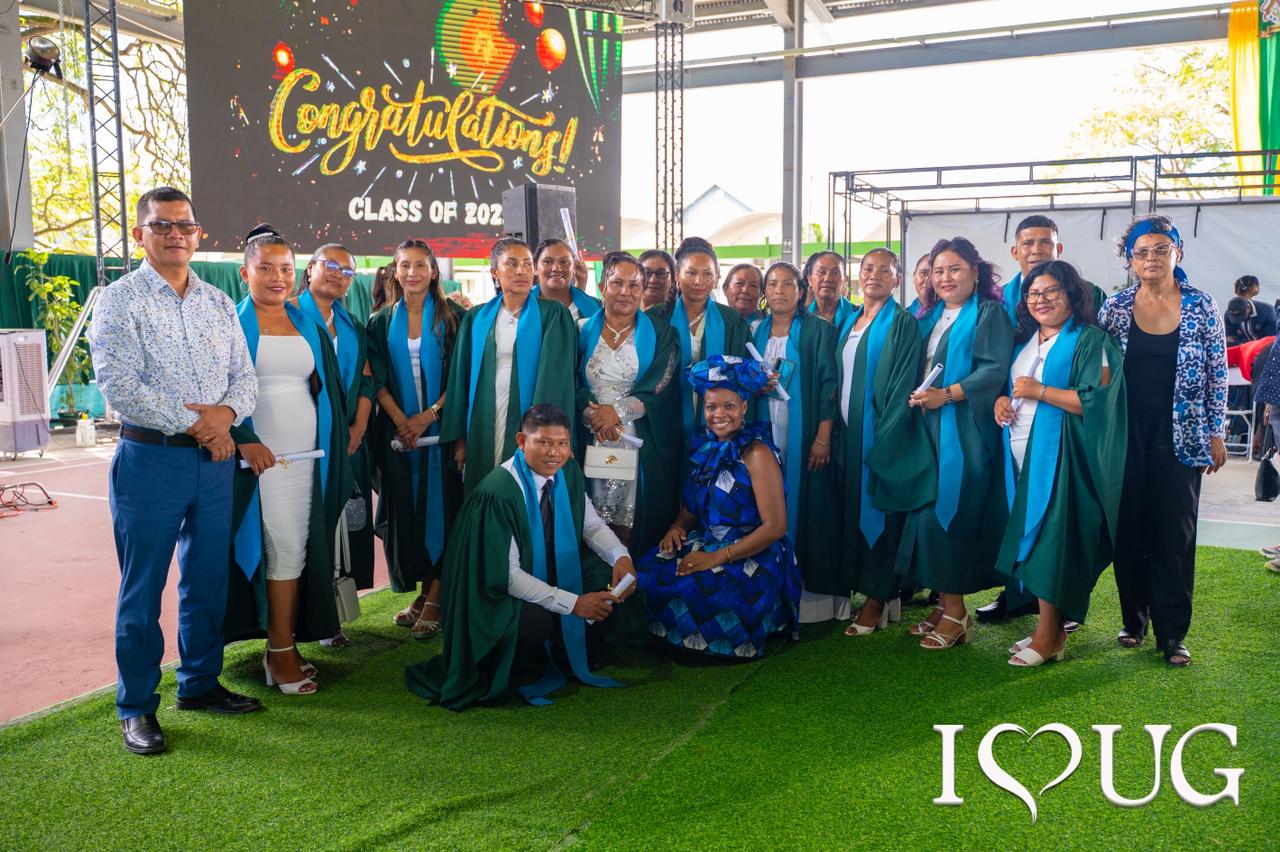
The first cohort of students graduating with the Certificate in Dual Language/Multilingual Practice in Education (CDL/MPE) from the University of Guyana, together with Deputy Chief Education Officer for Amerindian and Hinterland Education Development, Marti De Souza; Ms Charlene Wilkinson, lecturer in the Department of Language and Cultural Studies (first right); and Dr Tamirand Nnena De Lisser, Coordinator of the University of Guyana’s Guyanese Languages Unit.
Eighteen nursery school teachers from the South and Central Rupununi, Region 9 (Upper Takutu-Upper Essequibo), on November 22, 2025, graduated with the Certificate in Dual Language/Multilingual Practice in Education (CDL/MPE), giving a massive boost to the nation’s capacity to better support multilingual learners across the country. The achievement marks a significant milestone for the University of Guyana as it is the first time the university has produced graduates in this specialised field of study.
The teachers who participated in the year-long, full-time programme were drawn from the villages of Achiwib, Aishalton, Awarewaunau, Karaudarnau, Katoonarib, Katu’ur, Maruranau, Rupunau, Sand Creek, Sawariwau, Shea, Shiriri, and Shulinab.
Central to the CDL/MPE programme was its teacher/student-centred design, which encouraged participants to act as reflective practitioners and researchers. To this end, teachers/students in the programme were termed Junior Researchers (JRs), and the facilitators, Senior Researchers (SRs). JRs met twice weekly with SRs for three-hour sessions from October 2024 to July 2025. Through “proof of practice” methods, JRs presented classroom video recordings, conducted self-observations, created culturally relevant resources, and carried out interviews with parents and children to document local language use.
The programme generated several important resources, including the Wapichan Phonics Curriculum for the Nursery Levels and a series of Wapichan Big Books created by the JRs. While long-term outcomes will require further study, early classroom observations are promising. JRs report greater student participation, clearer comprehension, and increased pride among children using Wapichan in class.
As eloquently stated by one of the participants in the programme, “ Dual and multilingual education has helped my learners gain confidence, communicate better, and express themselves freely. They participate more and understand concepts faster, showing greater cultural awareness.”
Graduates described the programme as transformative for their teaching, confidence, and understanding of language in education. Lourinca James shared: “This programme reshaped my classroom into a more inclusive and empowering environment where children’s voices are heard. Multilingual education transforms classrooms into spaces where children can thrive.”
“Earning this certificate is a dream come true. It equips me to help revolutionise education in the Rupununi, build cultural identity, and enrich young minds,” said Denis Gomes, another graduate.
For Dolores Rodrigues, another graduate of the programme, the achievement “ represents my fellow Wapichan people.” She expressed gratitude to the parents and learners of Shea Nursery School, the MoE, IDB, UG lecturers, and her family for their support. “This programme has deepened my commitment to bilingual education. Thanks to my Heavenly Father through whom all things are possible,” she added.
“At first I wasn’t motivated, but this programme opened my eyes to the importance of language in the classroom. When I use children’s home language, learning becomes joyful and meaningful. This programme is even helping me as I pursue my degree,” said Tracy, another teacher who completed the programme.
Elain Joseph described the programme as “a truly transformative experience that strengthened my ability to use children’s home language to explain difficult concepts. I now feel more confident and better equipped to support diverse learners. I highly recommend this programme to other educators.”
For teacher Fatima Wilson, the journey has been “ a testament to resilience and determination. I am proud to be part of the first cohort to earn this certificate and excited to use my knowledge to positively impact my school and Guyana.”
Finally, Elsie Griffith, another graduate stated; “I am proud to be a certified university graduate. Though challenging, the programme was worth it. I am committed to creating classrooms where the Wapichan language is encouraged and included.”
The initiative has its genesis in May 2022 when Vice Chancellor Professor Paloma Mohamed Martin indicated to the Faculty of Education and Humanities (FEH) that the Ministry of Education (MoE) was seeking support for an intercultural bilingual education programme for Wapichan children. The Guyanese Languages Unit (GLU), which is part of the FEH, accepted the request and collaborated with the MoE to ensure the programme got off the ground. It was first envisioned as six short workshops but eventually evolved into a full-time university online programme, allowing teachers in remote areas to participate without leaving their villages.
The CDL/MPE Programme represents a significant step forward for mother tongue-based bilingual education in Guyana. Through reflective practice, community engagement, and renewed commitment to Indigenous language, the programme has laid a strong foundation for culturally grounded and pedagogically sound education for children.